Injection
Our Team
Equipment
- ComoNeo Kistler pressure sensor system (8 x pressure & 8 x temperature)
- Data flow Kistler (8 x pressure x 8 x temperature)
- Thermal image
- Cooling Flow meter
- Temperature checker
- all kind of scales
- Digital controller for
- Hot runner heating (tol. +-0.5%)
- Humidity checker
- and all necessary small tools
Our Capabilities
Navigation
Hotrunner vs. Coldrunner
Plastic components are in use by every industry and manufacturing these components through injection molding has come a long way. A wide range of equipment options exist depending on your application and capabilities. Generally speaking you have a choice between traditional cold runners or the more advanced hot runners. Each option comes with its own unique sets of pros and cons and so understanding the differences and how they relate to your application could have a big impact on your productivity and overall profitability.
// Longer cycle time
// Creates waste (sub-runners)
// Require additional auxiliary processing equipment (robotics, re-grinding machines/employee labor to remove runners, etc.)
// Secondary operations (degating, removal of cold runners, re-grinding etc.)
Under-standing Plastics
Polymers get their strength from a process called polymerization. During polymerization, small molecules called monomers combine to form long polymer chains. Thermosets are polymerized during processing while thermoplastics are polymerized before being processed.
Materials Overview
Plastic components are in use by every industry and manufacturing these components through injection molding has come a long way. A wide range of equipment options exist depending on your application and capabilities. Generally speaking you have a choice between traditional cold runners or the more advanced hot runners. Each option comes with its own unique sets of pros and cons and so understanding the differences and how they relate to your application could have a big impact on your productivity and overall profitability.
// Longer cycle time
// Creates waste (sub-runners)
// Require additional auxiliary processing equipment (robotics, re-grinding machines/employee labor to remove runners, etc.)
// Secondary operations (degating, removal of cold runners, re-grinding etc.)
Material Details
Plastic components are in use by every industry and manufacturing these components through injection molding has come a long way. A wide range of equipment options exist depending on your application and capabilities. Generally speaking you have a choice between traditional cold runners or the more advanced hot runners. Each option comes with its own unique sets of pros and cons and so understanding the differences and how they relate to your application could have a big impact on your productivity and overall profitability.
// Longer cycle time
// Creates waste (sub-runners)
// Require additional auxiliary processing equipment (robotics, re-grinding machines/employee labor to remove runners, etc.)
// Secondary operations (degating, removal of cold runners, re-grinding etc.)
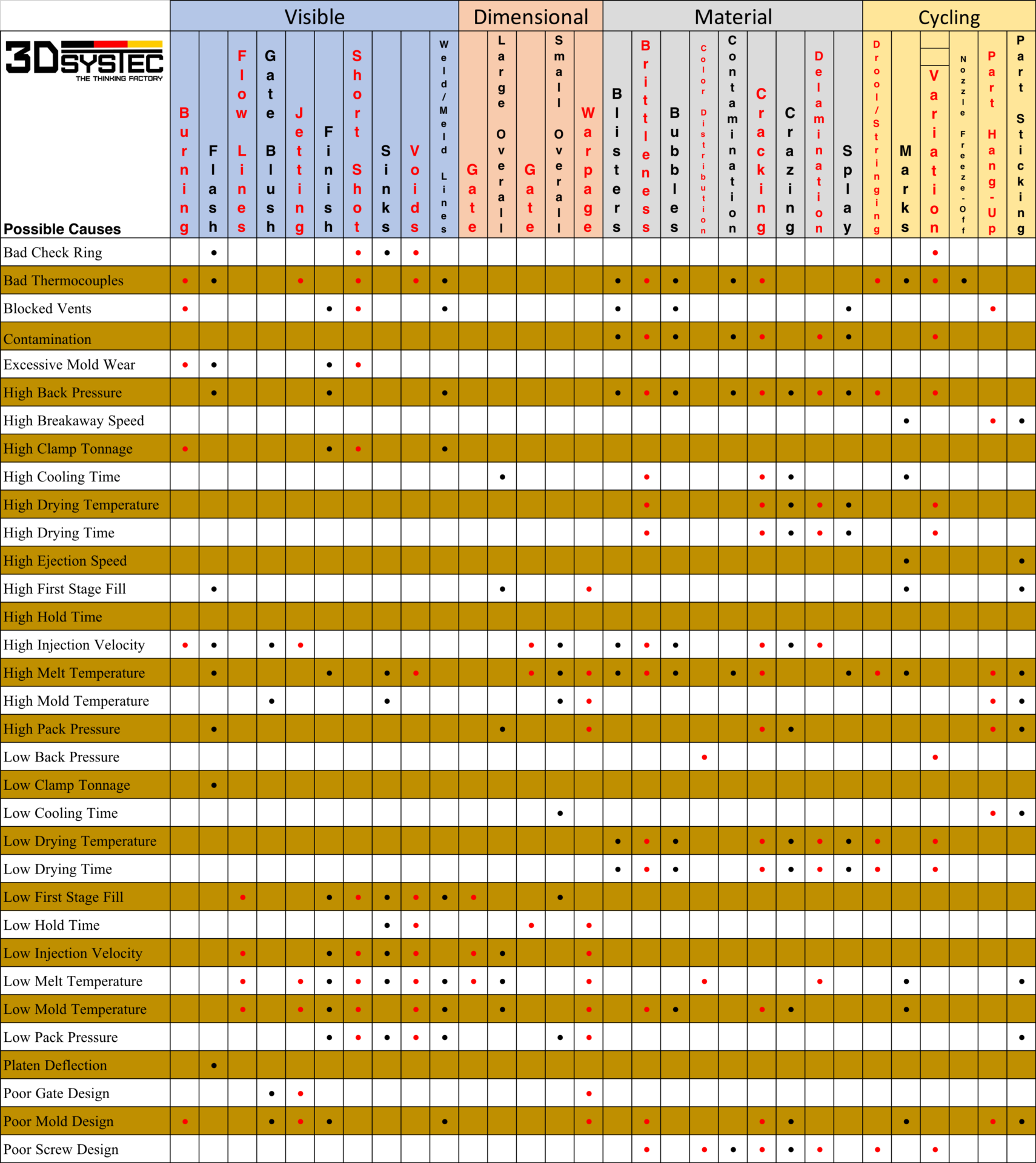
trouble shooting
Transfer should take place using screw position. The mold should be approximately 95% full at the time of transfer. The resulting part should be a visual short shot.
part defects
is excessive, unwanted material located on the edge of the part. This is a result of material passing through the parting line or between mold components.
Flash near the center of the mold or the gate may indicate low melt temperature as the problem. If the temperature of the melt is too high, the melt viscosity will drop, especially if the material degrades. This high-temperature melt with low viscosity may cause too much material to flow into the mold during 1 st stage fill, resulting in flash.
During 1 st stage injection, excessive amounts of material, high injection velocity, or a cavity filling imbalance can lead to flash. Also, excess 2 nd stage pressure or a low clamp tonnage can also lead to flash. Mold faults such as excessive wear or mold damage and machine faults like an inconsistent check ring or excessive platen deflection can also attribute to flash.
Sink are depressions on the part surface where the material shrinks away from the mold surface. Voids are sections in the center of the part where material shrinks away from itself, leaving a small cavity within the part. To ensure the defect is a void and not a gas bubble, you should mold parts at various injection speeds. If the defect remains stationary, it is most likely a void. Since both sinks and voids are the result of shrinkage, the causes and corrections are often similar.
A low melt temperature will cause larger pressure losses during injection. A high temperature melt causes additional shrinkage during cooling. Both of these conditions can result in sinks or voids.
During 1 st stage injection, insufficient shot size or low injection speed may cause sinks and voids to form. If too little pressure is used during 2 nd stage packing, insufficient material will enter the cavity to compensate for material shrinkage.
If the 2 nd stage time is insufficient, material will flow back through the gate before it seals which will result in sinks on the part in areas near the gate. A mold that is too cold (causing the polymer to freeze quickly) and a hot mold (that increases the amount of shrinkage) will both cause sinks and voids to occur.
defects causes